Updated 5 months ago
Fundamentals of Closed-Loop Hydronic Systems and Components
Written by
Michael Rimet
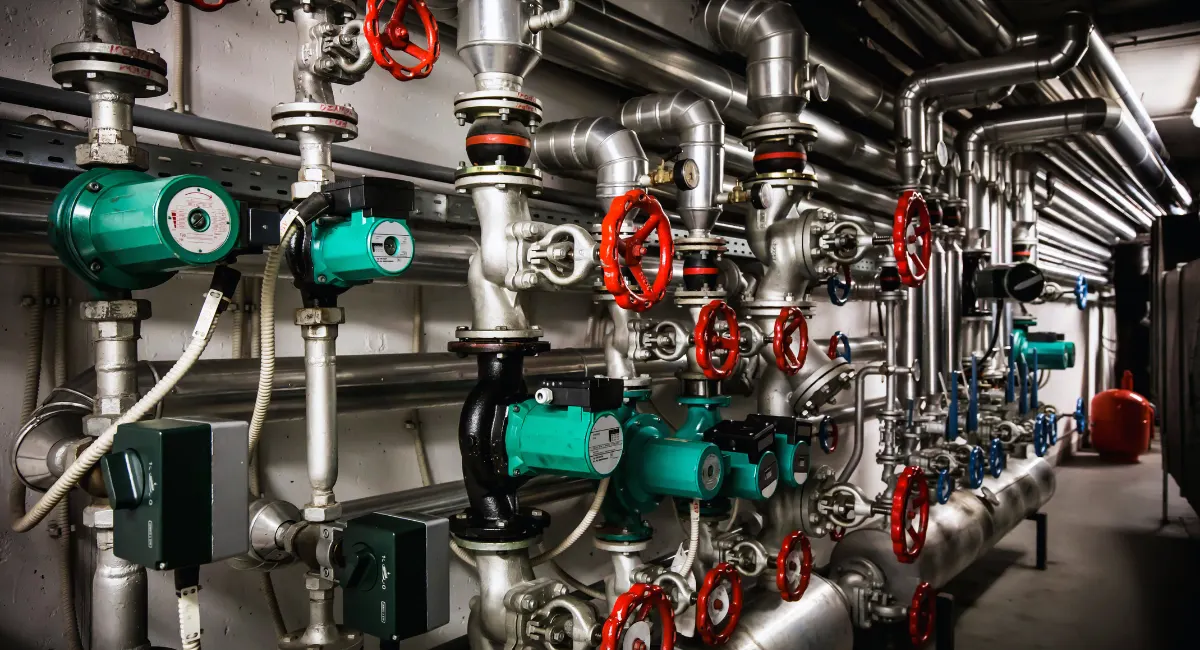
Nearly all hydronic systems, whether supplied by conventional heat sources or renewable energy heat sources, share common components. This article introduces those components and briefly describes their function.
The vast majority of hydronic heating systems are closed-loop systems. This means that the piping components form an assembly that separates the fluid in the system from contact with the atmosphere. If the system’s fluid is exposed to the atmosphere at any point, even through a tiny opening, that system is classified as an open-loop system.
Closed-loop circuits have several advantages over open loop systems. First, because they are sealed from the atmosphere, there is very little loss of fluid over time. Any slight fluid loss that occurs is usually the result of weeping valve packings or gaskets. These minor fluid losses typically do not create problems and can be automatically corrected with components discussed later in this article.
Another advantage of properly designed closed-loop systems is that the water within them contains a very small amount of dissolved oxygen. This greatly reduces the potential of corrosion, especially in systems containing iron or steel components.
Closed-loop systems can also operate under pressure. This helps in eliminating air from the system. It also helps in suppressing boiling within the system. The latter effect is especially useful in solar thermal systems where the fluid can sometimes reach temperatures well above the atmospheric boiling point of the fluids they contain.
Basic Closed-Loop Hydronic System
Figure 1 shows a basic closed-loop hydronic circuit. The box representing the heat source could be a boiler, a heat pump, a thermal storage tank heated by solar collectors, or some other heat-producing device. In this article, the heat source is assumed to be a closed device, sealed from the atmosphere, and capable of operating under some pressure.
The fluid in a hydronic circuit serves as a conveyor belt for heat. That heat is absorbed into the fluid at the heat source, carried through the distribution system by the fluid, and dissipated from the fluid into the building at one or more heat emitters. After releasing heat, the fluid returns to the heat source to absorb more heat and repeat the process. The circulator maintains flow through the circuit. The same fluid remains in the closed-loop circuit, often for many years. It never loses its ability to absorb, transport, or dissipate heat.

Figure 1. Basic closed-loop hydronic system.
Basic Hydronic Controllers
In an ideal system, the rate at which the heat source produces heat would always match the rate at which the building, or domestic water, requires heat. Unfortunately, this is seldom the case with any real system, especially one supplied by an intermittent heat source such as solar collectors or a wood-fueled boiler. For this reason, it is necessary to provide controllers that manage both heat production and heat delivery.
One of the most basic controllers is a thermostat. In many systems, it determines when flow is needed within the hydronic circuit based on room air temperature. For the simple hydronic circuit being described in this article, the thermostat turns the circulator on and off to create flow or stop flow though the circuit.
The thermostat’s “goal” is to keep the room air temperature at, or very close to, its setpoint temperature. If the room’s air temperature starts rising above the setpoint temperature, the thermostat turns off the circulator to stop further heat transport to the heat emitters. When the room temperature drops below the thermostat’s set-point, it turns on the circulator to start flow and resume heat transport.
Another common controller is called a high limit controller. Its function is to turn the heat source on and off so that the temperature of the fluid supplied to the distribution system remains within a useful range. High limit controllers are commonly used with heat sources such as boilers that generate heat by burning fuel. However, they may not be present in systems supplied by renewable heat sources. Instead, a 3-way mixing valve may be used to blend cool water returning from the heat emitters with heated water from the heat source, or a thermal storage tank, to achieve the desired supply temperature to the heat emitters.
Figure 2 shows a basic hydronic system supplied by a fuel-burning heat source. The circulator is assumed to be controlled by a room thermostat. The water temperature within the heat source is controlled by the high limit controller.

Figure 2. Basic hydronic circuit supplied by fuel-burning heat source. Two controllers (e.g., a room thermostat and high limit controllers) have been added to regulate heat generation and heat delivery.
Figure 3 shows a simple hydronic system where heat is supplied from a thermal storage tank. The water within this tank is assumed to be heated by a renewable energy heat source. A room thermostat turns the distribution circulator on and off based on room temperature.
A 3-way motorized mixing valve regulates the water temperature supplied to the distribution system. The mixing valve prevents the potentially high temperature water within the storage tank from being delivered directly to heat emitters that are intended to operate at lower water temperatures.

Figure 3. Simple hydronic system, where heat is supplied from a thermal storage tank.
Expansion Tank
Water expands when it is heated. This increase in volume is an extremely powerful but predictable characteristic that must be accommodated in any type of closed-loop hydronic system. Figure 4 shows an expansion tank added to the basic system. The expansion tank contains a captive volume of air. As the water within the system expands, it pushes into the expansion tank and slightly compresses this air. As a result, the pressure within the system rises slightly. As the system’s water cools, its volume decreases, allowing the compressed air to expand and system pressure to return to a lower value. This process repeats itself each time the system heats up and cools off.
Most modern hydronic systems use diaphragm-type expansion tanks. Such tanks contain air within a sealed flexible chamber. The sizing and placement of the system’s expansion tank are crucial to proper system operation.

Figure 4. Adding an expansion tank to the basic closed-loop circuit.
Pressure-Relief Valve
Consider the fate of a closed-loop hydronic system in which a defective controller fails to turn off the heat source after its upper temperature limit has been reached. As the water gets hotter and hotter, system pressure steadily increases due to the water’s expansion. This pressure could eventually exceed the pressure rating of the weakest component in the system. The consequences of a system component bursting at high pressures and temperatures could be devastating. For this reason, all closed-loop hydronic systems must be protected by a pressure-relief valve. This is a universal requirement of mechanical codes in North America and other countries.
Figure 5 shows a pressure-relief valve installed on the heat source. Because the heat source is part of the closed-loop system, this placement of the relief valve protects the entire system from excess pressure.

Figure 5. Adding a pressure relief valve to the heat source.
Make-Up Water System
Most closed-loop hydronic systems experience very minor water losses over time due to weepage from valve packings, pump seals, air vents, and other components. These losses are normal and must be replaced to maintain adequate system pressure. The common method for replacing this water is through an automatic make-up water system consisting of a pressure-reducing valve, back-flow preventer, pressure gauge, and shutoff valve.
Because the pressure in a municipal water main or private water system is often higher than the pressure-relief valve setting in a hydronic system, such water sources cannot be directly connected to the loop. A pressure-reducing valve, also known as a feed water valve, is used to reduce and maintain a constant minimum pressure within the hydronic system. This valve allows water into the system whenever the pressure on at its outlet side drops below the valve’s pressure setting. Most pressure-reducing valves have an adjustable pressure setting.
The backflow preventer stops any water that has entered the system from returning and possibly contaminating the potable water supply system. Most municipal codes require such a device on any heating system connected to a public water supply.
The shutoff valve is installed to allow the system to be isolated from its water source. An optional “fast-fill” valve is sometimes installed in parallel with the pressure-reducing valve so water can be rapidly added to the system. This is especially helpful when filling larger systems. The components that constitute a typical make-up water system are shown in Figure 6.
A purging valve is also shown in Figure 6. It allows most of the air within the circuit to exit as the system is filled with water. Purging valves consist of a ball valve, which is inline with the distribution piping, and a side-mounted drain port. To purge the system, the inline ball valve is closed and the drain port is opened. As water enters the system through the make-up water assembly, air is expelled through the drain port of the purge valve.

Figure 6. Adding a make-up assembly to the basic circuit.
Air Separator
An air separator is designed to separate air from water and eject the air from the system. Modern air separators create regions of reduced pressure as water passes through. The lowered pressure causes dissolved gases within the water to coalesce into bubbles. These bubbles are guided upward into a collection chamber, where an automatic air vent expels them from the system. For best results, the air separator should be located where fluid temperatures are highest, which is typically in the supply pipe from the heat source, as shown in Figure 7.

Figure 7. Adding an air separator to the basic circuit.
Putting It All Together
Figure 8 is a composite drawing showing all the components previously discussed in their proper positions within the simple hydronic circuit. By assembling these components, we have built a simple hydronic heating system. It must be emphasized, however, that just because all the components are present does not guarantee that the system will function properly. Combining these components is not a matter of choosing a favorite product for each and simply connecting them as shown.
Major subsystems such as the heat emitters and heat source have temperature and flow requirements that must be properly matched if they are to function together as a system. The objective is to achieve a stable, dependable, affordable, and efficient overall system. Failure to respect the operating characteristics of all components will result in installations that underheat, over-heat, waste energy, or otherwise disappoint their owners.

Figure 8. Composite drawing showing all the basic hydronic circuit components.
Need Help with HVACR Training Content?
If you need professionally developed HVACR training content, system design modules, or assessment programs focused on load calculations, refrigeration cycles, and equipment sizing, we can help. We create structured, standards-aligned content tailored for engineers, technicians, and contractors. Reach out to explore HVACR training content and curriculum development support.