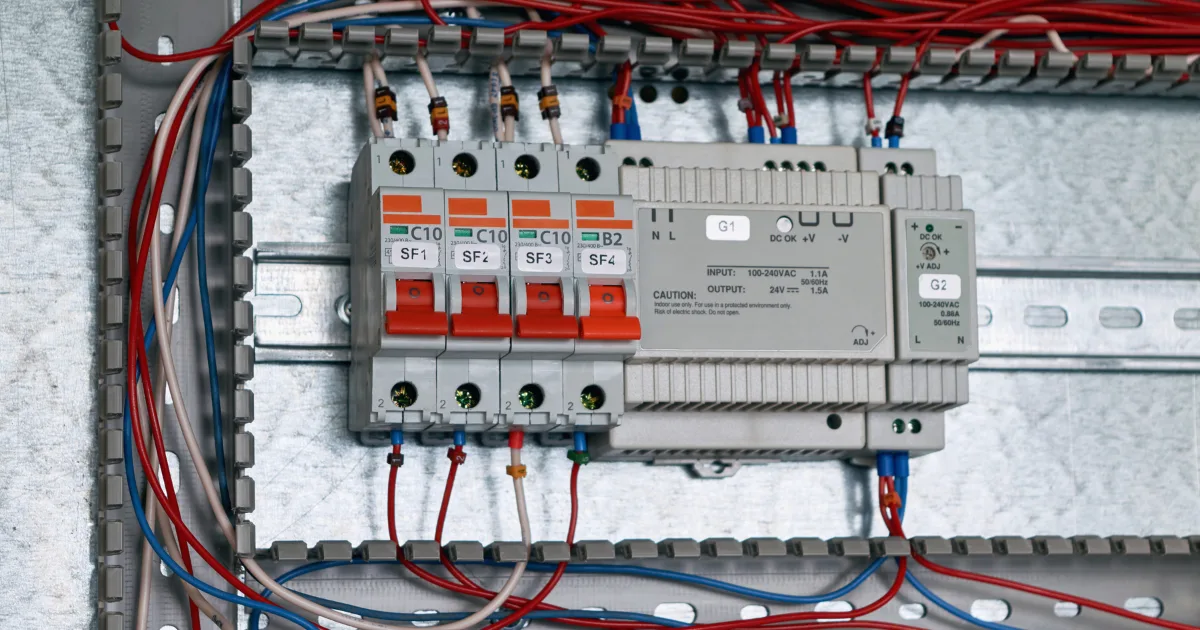
Sizing branch-circuit conductors and overcurrent protective devices (OCPDs) for continuous loads is one of the most frequent NEC tasks in commercial and industrial work. Done correctly, it prevents nuisance tripping and overheated terminations; done poorly, it leads to callbacks, failures, and code violations. This article explains the 125% rule for continuous loads, shows step-by-step sizing with real numbers, and highlights NEC sections you must apply in design and in the field.
Design Scenario
You must design two common continuous-load branch circuits:
- Scenario A: A 277 V lighting branch circuit supplying a continuous lighting load in a retail space.
- Scenario B: A 240 V Level 2 EV charger (EVSE), which the NEC explicitly treats as a continuous load.
Design Targets
- Select the OCPD rating (breaker).
- Select conductor size (copper THHN in EMT).
- Verify ampacity with temperature and conduit fill derating.
- Check voltage drop against the NEC Informational Note recommendations.
Engineering Explanation
- Continuous load is a load expected to run at maximum current for 3 hours or more (NEC Article 100).
- For branch-circuit conductors: minimum ampacity ≥ noncontinuous load at 100% + continuous load at 125% (NEC 210.19(A)(1)).
- For branch-circuit OCPDs: rating or setting ≥ noncontinuous at 100% + continuous at 125% (NEC 210.20(A)). A 100%-rated assembly is permitted if specifically listed and installed per listing; otherwise assume 125% for continuous loads.
- Conductor ampacity comes from Table 310.16, then adjusted/corrected per 310.15 (ambient temperature and number of current-carrying conductors). Finally, respect terminal temperature limits (NEC 110.14(C)) and the small-conductor rule (NEC 240.4(D)).
- EVSE is considered a continuous load (NEC 625.42).
- Voltage drop is not an enforceable code requirement but NEC Informational Notes recommend ≤3% on a branch circuit and ≤5% total feeder+branch (NEC 210.19 Informational Note; 215.2 (A) (2) Informational Note).
Scenario A — 277 V Lighting Branch Circuit (Continuous)
Given:
- Continuous lighting load: 3.30 kVA at 277 V single-pole to neutral.
- Raceway groups three identical lighting circuits in one EMT: for each circuit, one ungrounded and one neutral conductor. That is 6 current-carrying conductors (the neutrals carry load current and must be counted).
- Ambient temperature in the ceiling plenum: 40°C.
- Copper THHN/THWN-2 (90°C insulation) in EMT.
- Typical commercial equipment with 75°C rated terminations; however, small-conductor rule applies.
1. Load current
Iload = 3300 VA / 277 V = 11.91 A (continuous).
2. Minimum conductor ampacity per 210.19(A)(1)
Required ampacity = 125% × 11.91 A = 14.89 A.
3. OCPD per 210.20(A) and 240.6(A)
Required OCPD rating ≥ 14.89 A. Next standard rating is 15 A. A 20 A circuit is also common in commercial work; either is compliant if the conductor and loads match.
4. Choose a preliminary conductor size from Table 310.16 (before corrections)
- 14 AWG Cu: 25 A (90°C), 20 A (75°C), 15 A (60°C).
- 12 AWG Cu: 30 A (90°C), 25 A (75°C), 20 A (60°C).
5. Apply adjustment and correction factors (NEC 310.15; Table 310.16 used with 90°C rating for derating math; then check terminal limits per 110.14(C))
- Number of current-carrying conductors: 6 → adjustment factor = 0.80.
- Ambient temperature: 40°C; for 90°C insulation, correction factor ≈ 0.91.
Effective ampacity (14 AWG, 90°C basis):
25 A × 0.91 × 0.80 = 18.2 A.
Now apply terminal limitation and small-conductor rule (110.14(C), 240.4(D)): 14 AWG is limited to 15 A OCPD in general occupancy wiring. Therefore, the usable ampacity is limited to 15 A even though the adjusted 90°C value is 18.2 A.
Check against required 14.89 A: 15 A ≥ 14.89 A → acceptable with a 15 A breaker.
Effective ampacity (12 AWG, 90°C basis):
30 A × 0.91 × 0.80 = 21.84 A.
Terminal/small-conductor limits: 12 AWG is limited to 20 A OCPD by 240.4(D) unless an exception applies. For typical lighting, plan on 20 A max OCPD.
6. Select an OCPD and conductor
- Option 1 (lean): 15 A breaker with 14 AWG Cu THHN is compliant for this load and installation conditions.
- Option 2 (typical commercial): 20 A breaker with 12 AWG Cu THHN provides margin and standardization with other circuits.
7. Verify allowable continuous load on the selected OCPD
- 15 A breaker feeding a continuous load: maximum continuous load = 15 A × 0.80 = 12.0 A (the 125% rule restated as the “80% rule” for standard OCPDs). Our load is 11.91 A → acceptable.
- 20 A breaker: maximum continuous load = 20 A × 0.80 = 16.0 A → also acceptable.
8. Voltage drop check (NEC Informational Note)
Assume 12 AWG (Option 2), 277 V, 11.91 A, one-way length L.
Approximate R for 12 AWG Cu = 1.93 Ω/1000 ft at 75°F.
- If L = 150 ft: VD ≈ I × 2L × R/1000 = 11.91 × 2×150 × 1.93/1000 = 11.91 × 0.579 = 6.90 V → 6.90/277 = 2.5% (good, under 3%).
- If L = 250 ft: VD ≈ 11.91 × 2×250 × 1.93/1000 = 11.91 × 0.965 = 11.49 V → 11.49/277 = 4.1% (exceeds 3%; consider upsizing to 10 AWG or splitting the circuit).
Scenario B — 240 V Level 2 EVSE (Continuous)
Given:
- Nameplate continuous load: 40 A at 240 V (typical for a 9.6 kW EVSE).
- Dedicated branch circuit.
- Copper THHN/THWN-2 in EMT; assume a potential outdoor 40°C ambient and a raceway with two EV circuits together (4 current-carrying conductors).
1. Required ampacity and OCPD (NEC 625.42; 210.19(A)(1); 210.20(A))
- Required ampacity = 125% × 40 A = 50 A.
- OCPD rating ≥ 50 A → select 50 A breaker (240.6(A)).
2. Try 8 AWG Cu THHN first (common for 50 A when all terminations are 75°C)
- Table 310.16: 8 AWG Cu = 55 A (90°C), 50 A (75°C), 40 A (60°C).
- Derating for 4 CCC: factor = 0.80.
- Ambient 40°C, 90°C insulation correction ≈ 0.91.
Adjusted 90°C ampacity = 55 × 0.91 × 0.80 = 40.0 A.
Apply terminal limit: even with 75°C terminations (50 A), the adjusted value (40.0 A) governs → less than required 50 A. Not acceptable in this installation condition.
3. Upsize to 6 AWG Cu THHN
- Table 310.16: 6 AWG Cu = 75 A (90°C), 65 A (75°C), 55 A (60°C). Adjusted 90°C ampacity = 75 × 0.91 × 0.80 = 54.6 A. Apply terminal limit: 75°C rating is 65 A; adjusted value 54.6 A ≤ 65 A and ≥ 50 A required → acceptable.
- Therefore, for this hotter, shared-raceway installation, use 6 AWG Cu THHN with a 50 A breaker.
4. Note on termination temperature ratings (NEC 110.14(C))
- If every termination (breaker lugs and EVSE terminals) is listed 75°C and the installation had 3 or fewer CCC and ≤30°C ambient, 8 AWG would typically be acceptable for 50 A. Once you add CCC and higher ambient, derating pushes you to 6 AWG.

Figure. Branch Circuit Conductor Sizing for Continuous Loads using the 125% Rule
NEC References and Explanation
- Article 100: Continuous Load definition (≥3 hours at maximum current).
- 210.19(A)(1): Branch-circuit conductor sizing: 125% of continuous load + 100% of noncontinuous.
- 210.20(A): OCPD rating: 125% of continuous + 100% of noncontinuous; allowance for 100%-rated assemblies when listed.
- 240.4(D): Small conductor OCPD limits (e.g., 14 AWG Cu = 15 A, 12 AWG Cu = 20 A), unless a specific exception applies (motors, HVAC, welders, etc.).
- 240.6(A): Standard ampere ratings for OCPDs.
- 310.15 and Table 310.16: Conductor ampacity, with required adjustment (number of CCC) and correction (ambient).
- 110.14(C): Terminal temperature limitations; you may use 90°C insulation for derating math, but final ampacity cannot exceed limits imposed by terminal temperature ratings.
- 625.42: EVSE considered a continuous load by rule.
- 210.19(A) and 215.2 Informational Notes: Recommend 3%/5% voltage drop.
Practical Design Considerations
- Termination temperature ratings: For equipment 100 A or less and 14 AWG through 1 AWG, terminations are often 60°C unless marked 75°C. Many commercial panelboards and breakers are 75°C today, but you must verify labeling. Always perform derating using the 90°C column for 90°C insulation, then apply terminal limits per 110.14(C).
- Conductor adjustment/correction: Count neutrals properly. In a 277 V 2‑wire circuit, the neutral is current-carrying and counts toward the CCC total. Grouping multiple circuits in one raceway drives derating quickly.
- Ambient temperature: Roof spaces and mechanical rooms routinely exceed 30°C. Use the appropriate correction factor. Sun-heated raceways outdoors often justify upsizing.
- Voltage drop: Long runs on 277 V lighting can exceed the 3% recommendation quickly. Consider circuit segmentation, upsizing to 10 AWG, or locating panels closer to the load.
- 100% rated devices: If you truly need full 100% utilization, use a listed 100%-rated breaker/panel assembly and follow all listing conditions (often including conductor size and enclosure ventilation). Otherwise, assume the 125% continuous rule.
- Small conductor rule: Even if adjusted 90°C math yields higher ampacity, 240.4(D) caps OCPD ratings for 14, 12, and 10 AWG (with specific exceptions). Don’t fight it—design within those limits.
- Nonlinear loads: Where triplen harmonics are significant (e.g., 3‑phase 4‑wire systems feeding nonlinear electronic loads), the neutral can be a CCC even in multiwire circuits. Verify CCC counts for proper derating (310.15).
Final Result and Design Summary
Scenario A (277 V lighting, 3.30 kVA continuous)
- Required ampacity and OCPD ≥ 14.89 A.
- Compliant options:
- 15 A breaker with 14 AWG Cu THHN (after derating, limited to 15 A by 240.4(D)); verify voltage drop for run length.
- 20 A breaker with 12 AWG Cu THHN (typical practice); at 40°C and 6 CCC, adjusted 90°C ampacity ≈ 21.84 A, but OCPD limited to 20 A by 240.4(D); confirm voltage drop (≤150 ft one-way recommended for this load on 12 AWG to stay under ~3%).
Scenario B (EVSE 40 A continuous at 240 V)
- Required ampacity and OCPD = 50 A.
- If ≥40°C ambient and 4 CCC, use 6 AWG Cu THHN on 50 A breaker (adjusted ampacity ≈ 54.6 A).
- If ≤30°C ambient and ≤3 CCC with 75°C terminations, 8 AWG Cu THHN on 50 A breaker is typically acceptable.
Key Takeaways for Engineers
- The 125% rule applies to both branch-circuit conductors and OCPDs for continuous loads (210.19(A)(1), 210.20(A)).
- Do derating in the 90°C column for 90°C insulation, then check terminal limits and 240.4(D).
- EVSE, many lighting applications, and certain process loads are continuous by definition or operation; plan for it early.
- Grouping circuits and higher ambient temperatures are the two most common reasons a “paper design” fails in the field—account for both.
- Validate voltage drop; upsizing a conductor one size is often cheaper than troubleshooting dim lighting or EVSE nuisance issues after turnover.
Need Help with NEC Training Content?
If you need professionally developed NEC training content, course modules, or calculation-driven exercises on topics like continuous-load sizing, derating, and conductor selection, We can help. We develop clear, code-accurate materials tailored to engineers, electricians, and inspectors. Reach out to explore NEC-focused training content and curriculum support.