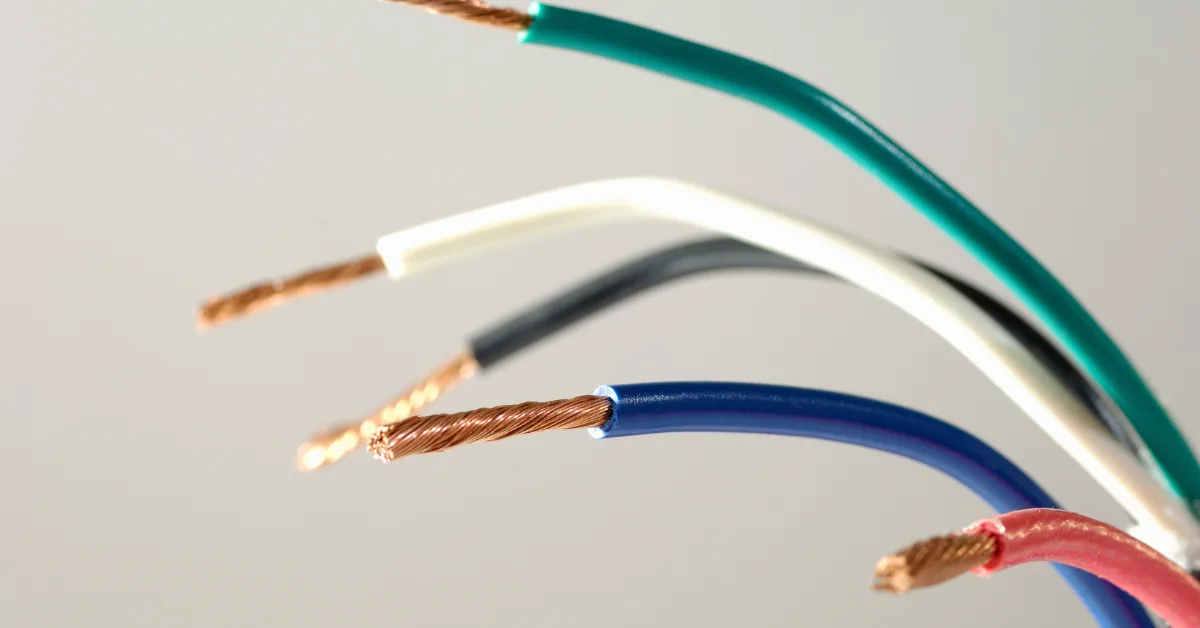
For grounding and grounded conductors, this section simply directs the reader to comply with other Code rules that cover conductor color-coding or color-identification schemes. It directs that "grounded" and "grounding" conductors in branch circuits utilize the specific color identification given in 200.6 and 250.119. Those rules generally reserve the color green for equipment grounding conductors and white, gray, or three continuous white stripes on other than green-colored insulation for the grounded conductors in branch circuits.
It should be noted that the rules on color coding of conductors given in Article 210 apply only to branch-circuit conductors and do not directly require color coding of feeder conductors. But the rules given in 200.6 and 250.119 must generally be observed, and would apply to feeder and service conductors.
215.12 also requires identification of phase legs of feeders to panelboards, switchboards, and so forth—and that requires some technique for marking the phase legs; those provisions are now harmonized with the ones here for branch circuits. Note that many design engineers have insisted on color coding of feeder conductors all along to afford effective balancing of loads on the different phase legs.
Color identification for branch-circuit conductors is divided into three categories:
1. Grounded Conductor. As indicated, grounded conductors must satisfy 200.6. That rule generally requires that the grounded conductor of a branch circuit (the neutral of a wye system or a grounded phase of a delta) must be identified by a continuous white or gray color for the entire length of the conductor, or have three continuous white (or gray) stripes for its entire length on other than green insulation.
Where wires of different systems (such as 208/120 and 480/277) are installed in the same raceway, box, or other enclosure, the neutral or grounded wire of one system must be white or gray or have the three continuous white (or gray) stripes on other than green insulation; and the neutral of the other system must be white with a color stripe, or be gray if the first one is white, etc., or it must be otherwise distinguished—such as by painting or taping. The point is that neutrals of different systems must be distinguished from each other when they are in the same enclosure [200.6(D) and Figure 1].

Figure 1. Separate identification of ungrounded conductors is required only if a building utilizes more than one nominal voltage system. Multiple systems within a premises wiring system that operate at the same voltage classification are permitted to share the same color code. Neutrals must be color-distinguished if circuits of two voltage systems are used in the same raceway, but not if different voltage systems are run in separate raceways. [Section 210.5(C).]
2. Hot Conductor. The NEC requires that individual hot conductors be identified where a building has more than one nominal voltage system. In contrast to the rule for grounded circuit conductors, the coding rules for these wires apply anytime multiple voltage systems exist in a building, whether or not they happen to share an enclosure. Another difference is that the grounded conductor identification scheme applies over the entire length of the conductor for 6 AWG and smaller conductors, but the ungrounded conductors need only be identified at "termination, connection, and splice points."
3. Grounding Conductor. An equipment grounding conductor of a branch circuit (if one is used) must be color-coded green or green with one or more yellow stripes—or the conductor may be bare [250.119].

Figure 2. Branch Circuit Conductor Identification
In part (C) of 210.5, an important rule for branch circuits requires some means of identification of hot (ungrounded) conductors of branch circuits in a building that contains wiring systems operating at two or more different voltage levels. This means that one needs to identify all branch circuits including individual branch circuits, as well as single-phase and 3-phase power circuits whether or not a neutral is part of the branch circuit.
However, every branch-circuit panelboard—in both the 208Y/120-V system and the 408Y/277-V system—must have the means of identification marked on it. The panel identification label needs to only specify the system in use for circuits originating within it. It is not necessary to create complicated, fully reciprocal labels that describe every color code for every voltage system in the building. Such identification is also required in 215.12 for feeders, including the marking of feeder panels.
As of the 2017 NEC, the burden of circuit wiring identification has been significantly reduced in a case where a new voltage system is being added to an existing, already wired occupancy with one or more voltage systems in place.
- The exception allows the new system to be identified using whatever system has been designed for it, without triggering a requirement that the existing wiring be changed to accommodate and differentiate from the new system. The exception is contingent on markings being present on all distribution equipment that originates branch circuits on the new system, in addition to the posting required in (C)(1)(b), which specifically includes the phrase "other unidentified systems exist on the premises."
This Code rule and that given in 215.12 restore the need to identify phase legs of branch and feeder circuits where more than one voltage system is used in a building. For instance, a building that utilizes both 208Y/120-V circuits and 480Y/277-V circuits must have separate and distinct color coding of the hot legs of the two voltage systems—or must have some means other than color coding such as tagging, marking tape (color or numbers), or some other identification that will satisfy the inspecting agency. This new rule further states that the "means of identification must be permanently posted at each branch-circuit panelboard or similar branch-circuit distribution equipment"—to tell how the individual phases in each of the different voltage systems are identified (Figure 1).
The wording of the new rule requires that the "means of identification" must distinguish between all conductors, including the system. But, if a building uses only one voltage system—such as 208Y/120 V or 240/120 V single phase—no identification is required for the circuit phase (the "hot" or ungrounded) legs. And where a building utilizes two or more voltage systems, the separate, individual identification of ungrounded conductors must be done whether the circuits of the different voltages are run in the same or separate raceways.
Color coding of circuit conductors (or some other method of identifying them), as required by 210.5(C), is a wiring consideration that deserves the close, careful, complete attention of all electrical people. Of all the means available to provide for the ready identification of the 2- or 3-phase legs and neutrals in wiring systems, color coding is the easiest and surest way of balancing loads among the phase legs, thereby providing full, safe, effective use of total circuit capacities.
In circuits where color coding is not used, loads or phases get unbalanced, many conductors are either badly underloaded or excessively loaded, and breakers or fuses sometimes are increased in size to eliminate tripping due to overload on only one phase leg. Modern electrical usage—for reasons of safety and energy conservation, as well as full, economic application of system equipment and materials—demands the many real benefits that color coding can provide.
For the greater period of its existence, the NEC required a very clear, rigid color coding of branch circuits for good and obvious safety reasons.
- Color coding of hot legs to provide load balancing is a safety matter. 210.11(B) requires balancing of loads from branch-circuit hot legs to neutral.
- The rule of 220.61 bases sizing of feeder neutrals on clear knowledge of load balance in order to determine "maximum unbalance."
- And mandatory differentiation of voltage levels is in the safety interests of electricians and others maintaining or working on electrical circuits, to warn of different levels of hazard.
Because the vast majority of electrical systems involves no more than two voltage configurations for circuits up to 1000 V, and because there has been great standardization in circuit voltage levels, there should be industrywide standardization on circuit conductor identifications.
A clear, simple set of rules could cover the preponderant majority of installations, with exceptions made for the relatively small number of cases where unusual conditions exist and the local inspector may authorize other techniques. Color coding should follow some basic pattern—such as the following:
- 120-V, 2-wire circuit: grounded neutral—white; ungrounded leg—black
- 240/120-V, 3-wire, single-phase circuit: grounded neutral—white; one hot leg—black; the other hot leg—red
- 208Y/120-V, 3-phase, 4-wire: grounded neutral—white; one hot leg—black; one hot leg—red; one hot leg—blue
- 240-V, delta, 3-phase, 3-wire: one hot leg—black; one hot leg—red; one hot leg—blue
- 240/120-V, 3-phase, 4-wire, high-leg delta: grounded neutral—white; high leg (208-V to neutral)—orange; one hot leg—black; one hot leg—blue
- 480Y/277-V, 3-phase, 4-wire: grounded neutral—gray; one hot leg—brown; one hot leg—orange; one hot leg—yellow
- 480-V, delta, 3-phase, 3-wire: one hot leg—brown; one hot leg—orange; one hot leg—yellow
By making color coding a set of simple, specific color designations, standardization will ensure all the safety and operating advantages of color coding to all electrical systems. Particularly today, with all electrical systems being subjected to an unprecedented amount of alterations and additions because of continuing development and expansion in electrical usage, conductor identification is a regular safety need over the entire life of the system. (Figure 3.)

Figure 3. Although only required for branch circuits in buildings with more than one nominal voltage, color identification of branch-circuit phase legs is needed for safe and effective work on grouped circuits. [Section 210.5(C).]
Of course, there are alternatives to "color" identification throughout the length of conductors. Color differentiation is almost worthless for color-blind electricians. And it can be argued that color identification of conductors poses problems because electrical work is commonly done in darkened areas where color perception is reduced even for those with good eyesight.
- The NEC already recognizes white tape or paint over the conductor insulation end at terminals to identify neutrals (200.6).
- Number markings spaced along the length of a conductor on the insulation (1, 2, 3, etc.)—particularly, say, white numerals on black insulation—might prove very effective for identifying and differentiating conductors.
- Or the letters "A," "B," and "C" could be used to designate specific phases.
- Or a combination of color and markings could be used. But some kind of conductor identification is essential to safe, effective hookup of the ever-expanding array of conductors used throughout buildings and systems today.
And the method used for identifying ungrounded circuit conductors must be posted at each branch-circuit panelboard to comply with requirements of 210.5(C). Note that 200.6(D) imposes the same requirement on grounded conductors if different systems share a common enclosure at any point. For usability, the marking protocol for both types of conductors should be grouped on the same legend plate or within the same documentation.
The NEC addresses this by recognizing that some occupancies with very sophisticated operations maintain the circuit identification protocols in documentation at central points. If such documentation is "readily available," Secs. 210.5(C) and 200.6(D) now make the same allowance for grounded conductors and allow such on-site records or manuals to substitute for panelboard markings. This degree of sophistication becomes important when, for example, multiple branch circuits running at the same voltage but derived from differing separately derived systems happen to arrive in a common enclosure for some reason. In such cases, it may be very useful to know which wire is which, and the simple use of color would probably not be adequate for this purpose.
Part (C)(2) of this section covers color coding for the ungrounded conductors of branch circuits that are derived from dc systems operating above 60 V.
- The requirement follows the customary industry practice of using red for positive and black for negative, either as the entire insulation color or in the form of a stripe along the entire length. For obvious reasons, if a stripe is used, the contrasting color cannot be that of the opposite polarity, or white, gray, or green.
- Imprinted positive (+) and negative (-) signs on the conductor insulation at least every 2 ft in accordance with 310.120(B) is also permitted.
- Another option is using approved permanent marking methods such as shrink tubing with the same identifying markings.
Just as in the case of 200.6 for coding grounded conductors, the rule for 6 AWG and smaller applies over the length of the conductor. For 4 AWG and larger, the rule only applies to "termination, connection, and splice points" and can be met by taping or tagging or other approved means. Note that in the case of approved permanent markings (shrink tubing, etc.), the same limitation applies equally to smaller conductors. It would clearly be prohibitive to require such methods to be used over the entire length of the conductor.