Updated 5 months ago
History of the NEC: Evolution of the National Electrical Code Explained
Written by
Ahmed Sheikh
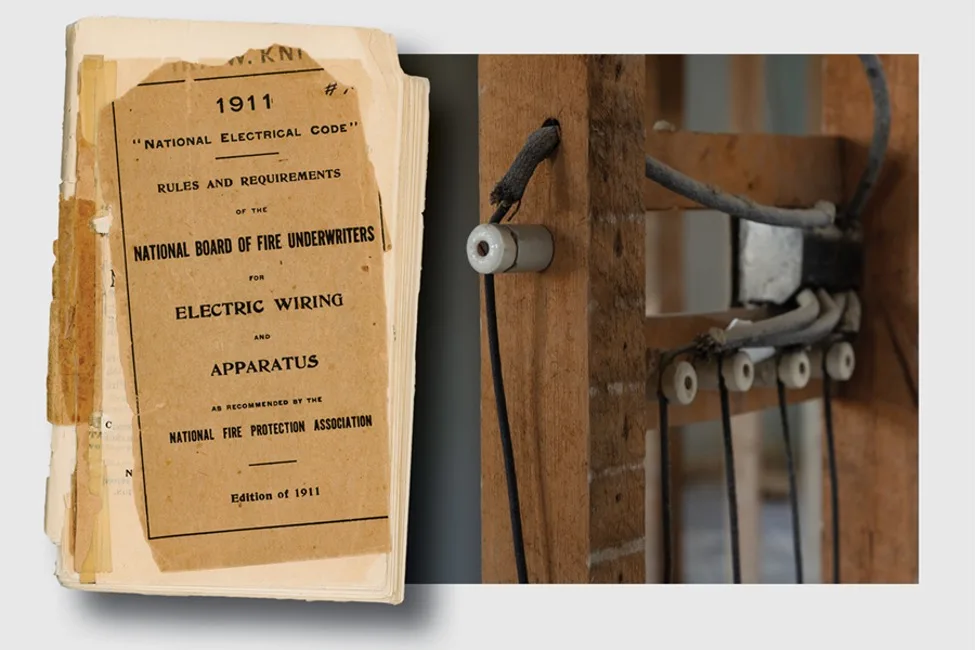
The National Electrical Code was originally drawn in 1897 as a result of the united efforts of various insurance, electrical, architectural, and allied interests. The original Code was prepared by the National Conference on Standard Electrical Rules, composed of delegates from various interested national associations. Prior to this, acting on an 1881 resolution of the National Association of Fire Engineers' meeting in Richmond, Virginia, a basis for the first Code was suggested to cover such items as identification of the white wire, the use of single disconnect devices, and the use of insulated conduit.

Early editions of the National Electrical Code (NEC), showcasing its evolution from 1897 to the early 1900s.
In 1911, the National Conference of Standard Electrical Rules was disbanded, and since that year, the National Fire Protection Association (NFPA) has acted as sponsor of the National Electrical Code.
Beginning with the 1920 edition, the National Electrical Code has been under the further auspices of the American National Standards Institute (and its predecessor organizations, United States of America Standards Institute, and the American Standards Association), with the NFPA continuing in its role as Administrative Sponsor. Since that date, the Committee has been identified as "ANSI Standards Committee C1" (formerly "USAS C1" or "ASA C1").
Major milestones in the continued updating of successive issues of the National Electrical Code since 1911 appeared in 1923, when the Code was rearranged and rewritten; in 1937, when it was editorially revised so that all the general rules would appear in the first chapters followed by supplementary rules in the following chapters; and in 1959, when it was editorially revised to incorporate a new numbering system under which each section of each article is identified by the article number preceding the section number. The 1937 edition also included an introduction for the first time, and many of its most important provisions survive, almost verbatim, in Article. 90 today. That article number, together with much of what is familiar about the Code today, began with the 1959 organizational changes.
In addition to an extensive revision, the 1975 NEC was the first Code to be dated for the year following its actual release. That is, although it was released in September of 1974, instead of being called the 1974 Code—as was done for the 1971 and all previous editions of the NEC—this Code was identified as the 1975 Code. That's the reason there appears to be 4 years, instead of the usual 3, between the 1971 and 1975 editions. The purpose was to have the named code year agree with the effective dates of adoption in, at least, the early adopting jurisdictions.

Evolution of the National Electrical Code (NEC): Key Editions from 1920 to 1975
Due to the proliferation of premises-owned medium-voltage systems, the 1999 Code notably moved those requirements out of the old Article. 710 and into Chapters. 1 through 4. The 2005 NEC made a notable reorganization of almost all of Chapter. 3, resulting in new article numbers for almost every wiring method. This edition editorially underlined medium-voltage coverage by moving the majority of this content into articles that were either created or relocated to end in the digit "5". New Articles. 235, 245, and 305 largely consist of content originating in other articles, and Articles. 315, 395, and 495 are essentially renumbering of former Articles. 311, 399, and 490.
In addition to medium-voltage content, the 2023 edition extensively reorganizes content regarding control circuits in Chapter. 7. Class 1 circuits now reside in new Article. 724, ITC cable, formerly Article. 727, is now Article. 335, and new Article. 722 contains the cabling requirements for limited-energy wiring generally. This change avoids the needless duplication of requirements in multiple power-limited articles. New Article. 726 breaks new ground, covering Class 4 circuits for the first time.
Two articles address new wiring methods. Article 369 covers Insulated Bus Pipe and Article. 371 covers Flexible Bus Systems, both of which have very specialized applications. Finally, new Article. 512 brings attention to cannabis processing operations that involve highly flammable solvents. Two articles have also been removed. The content of former Article. 510 has been distributed into the specialized articles that follow it, and former Article. 712 has been deleted because its content largely duplicated content in Article. 705.
For many years, the National Electrical Code was published by the National Board of Fire Underwriters (now American Insurance Association), and this public service of the National Board helped immensely in bringing about the wide public acceptance that the Code now enjoys. It is recognized as the most widely adopted Code of standard practices in the United States.
The National Fire Protection Association first printed the document in pamphlet form in 1951 and has, since that year, supplied the Code for distribution to the public through its own offices and through the American National Standards Institute. The National Electrical Code also appears in the National Fire Codes, issued annually by the National Fire Protection Association.